|
Bees at home in a compost bin
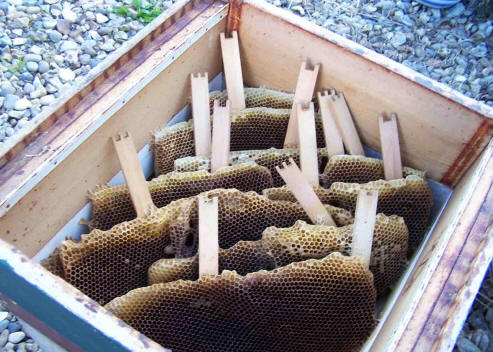
Bee combs in a box after brood hatching |
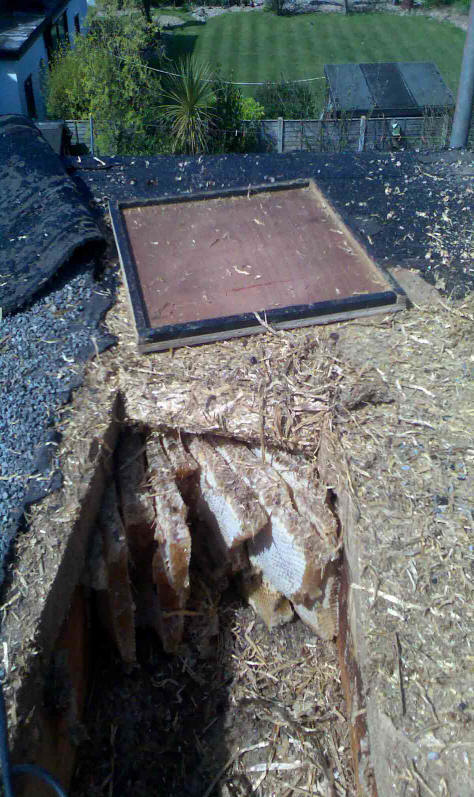
Bee colony in a flat roof |
|
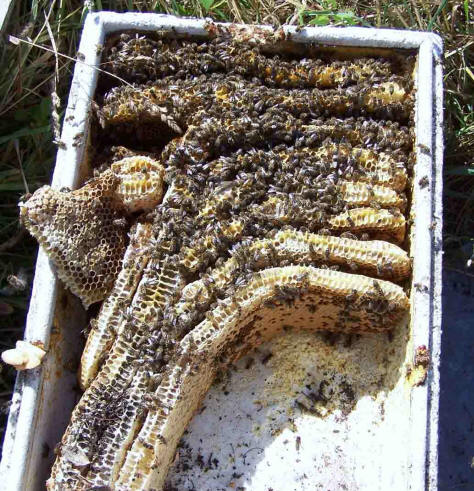
Bees have made a home in a plastic box. |
Over the last few years I have been asked to rescue a number of colonies of bees from houses and other places where they have made a home but are not appreciated. I have evolved a system to do this that I thought I would share.
You will need a bee suit and rubber gloves if desired and:
1. Large plastic storage boxes with tight fitting lids to store and combs with honey.
2. A brood box with frames and at least one drawn comb, solid hive floor and top board.
3. A second brood box with a queen excluder permanently fixed to the bottom – I use a wire excluder as it is more robust. A number of pieces of wood to separate the combs – frame side bars are ideal.
4. A garden sprayer filled with water.
5. A skep or box, bee brush or bundle of grass, a kitchen knife, smoker, bucket of water to wash honey from hands.
The first challenge is to gain access to the combs. In this case the colony was in the hollow wall of a wooden building being used as a toilet block at a fishing lake. The boards were carefully removed from the wall so that they could be reinstated later.
The bees were sprayed with water to reduce the amount of flying. Then the combs were cut out one by one and the bees brushed (with a bundle of long grass or bee brush) onto a board in front of the hive containing a set of frames and comb.
The combs with no brood were put into the plastic boxes and the lids replaced.
The combs with brood were propped up in the second box with the pieces of wood or frame side bars to separate them from each other.
The remaining bees in the wall were sprayed with water and brushed into the skep or box and shaken onto the board in front of the hive.
When most of the bees were captured the boxes were wrapped up and taken to my apiary where the box of brood was places on top of the brood chamber of bees and frames.
After three or four weeks the bees can be brushed off the combs in the top box in front of the lower box and the top box removed.
When the boards were re-instated on the hut wall a sheet of polythene was used to prevent swarms from moving into the space (smelling nicely of bees!) in the future
I hope this is clear – if you want to talk to me about the process do contact me on [email protected]
|
Bees at home in a compost bin
Bee combs in a box after brood hatching |
Bee colony in a flat roof |
|
Bees have made a home in a plastic box. |
Contact us · Home ·